Showing posts with label Photo Industry. Show all posts

Tuesday, October 1, 2013

New Commercial Work: Salomon Sports and Stevens Pass

As the leaves have started turning and the temperature gets colder, we say goodbye to another Summer. And with that, the start of another ski season. Nothing marks this on my calendar more than seeing the first of the ski magazines and movies of the season. So, without further ado, here's the first crop of images I was fortunate enough to work on last winter.

Promotional poster for Stevens Pass Mountain Resort

Stevens 2014 Winter Poster

Salomon poster for Vincent Gagnier


FW13.Freeski.Posters.Gagnier_LR 3

Wednesday, July 25, 2012

Shooting Action with Strobes Using Hyper-Synch

7_18_12_Stevens_721
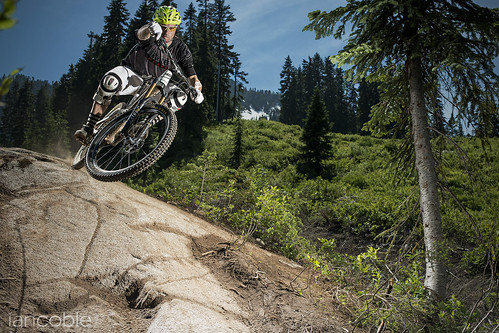
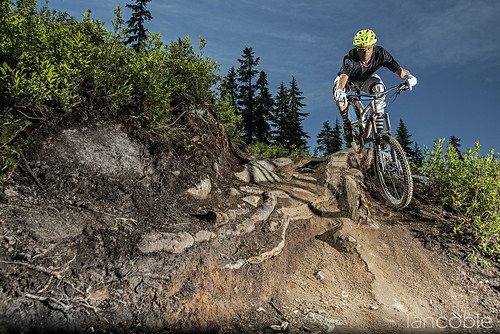
Lars Sternberg at Stevens Pass. Shot at 1/3200th of a second

This post is going to be super heavy on camera nerdy tech jargon.  If you're not a dorky photographer, this might not make a lot of sense... but please keep reading and enjoy!

That disclaimer aside, I started working with Pocket Wizards to trigger my off camera strobes roughly 5 years ago. Last year, I was fortunate enough to get contacted by them to help in the Beta testing of their Flex TT5 and Mini TT1 units. I was super excited to start testing these as they promised the new ability to synch strobes above the normal 1/250th of a second shutter speed. For action shooters, this is a dream come true. The previous limitations of technology prevented photographers from shooting above 1/250th of a second. Instead, we had to rely on the flash duration of our strobes to freeze the action. Beyond just the ability to freeze action, it also prevented you from under exposing a scene to achieve a heavy dramatic look.

7_18_12_Stevens_701

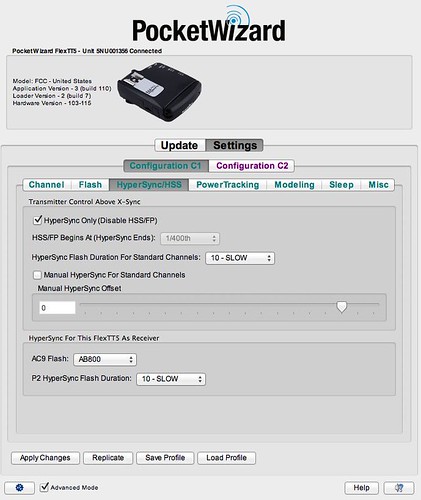
Although I've been working with the Flex and Mini units for over a year now, I was still having trouble achieving a proper hyper-synch. Occasionally they would work at speeds over 1/250th, but it wasn't always reliable. Fast forward though to last week and the game changed. With the release of Firmware Version 3.110, any issues I had previously had with the units disappeared. (There are some adjustments that need to be made in the Pocketwizard Utility in order to achieve accurate hyper synch. Below is a screen shot of how mine are set up for use with Elinchrom Ranger RX's).

PW Setup

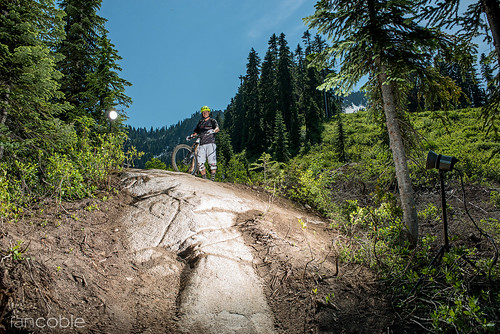
I went out and shot with pro mountain biker, Lars Sternberg last week to put the Flex and Mini units to the test. The results were astounding! Shooting with a Nikon D800 and two Elinchrom Ranger RX packs (utilizing the S heads, NOT the A heads), I was able to get full synch at 1/1250th. A HUGE jump from 1/250th.

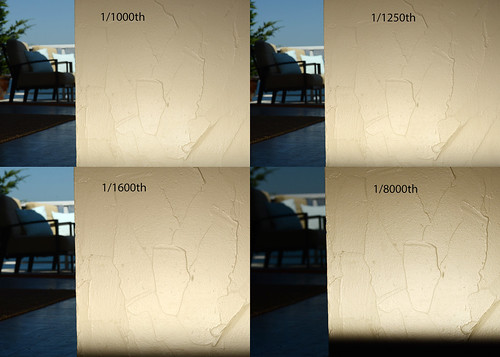
However, I was able to continue pushing synch speed higher with hardly any clipping. At 1/1600th I had very slight clipping at the base of the frame... and I mean hardly noticeable. As shutter speed was pushed higher, the clipping gradually grew, but very minimally. Even at 1/8000th of a second, the clipping was still very minimal (see reference files below).

synch speeds

I know some will look at the above and say that there is a bit of darkness at the tops of the frames that could be construed as shutter lag. However, it's affect is so minimal compared to normal shutter lag, that it can easily be compensated for by increasing the strobe's power or camera's f-stop by +1/2 a stop.

Additionally, with the huge file sizes being output by the D800 (36.2MP), the tiny clipping seen even at the fastest shutter speeds can easily be cropped out without losing the detail or size of the file.

A big thanks to the people at Pocket Wizard for working with me on the beta testing of these units. I'm excited to see the new possibilities that this will open for action shooters utilizing strobes. Hope this article helps some of you. Good luck and happy shooting.

7_18_12_Stevens_700
1/3200th with no cropping of shutter lag at bottom of frame

Monday, June 20, 2011

New Google Image Search Options

In case you hadn't heard, Google just launched a new image searching tool. This was just brought to my attention a couple of days ago and I finally had a chance to dig into and run a few tests. In short, google users can now upload a photo and search the web to see where it's being used. For photographers, this is a great way to see if your photos are being pirated, stolen or otherwise mis-used. Getty Images has had this technology for a few years, but it's now available to everyone... finally.
google home

I did a couple of tests with photos of mine that have been heavily used and was amazed at how quickly it came up with results. In some cases it even came up with the names of people pictured in the photos.

google 2

Similar search engines such as Tin Eye offer similar search engines (and have been around for much longer). However, I tested numerous images on both platforms, and Google won hands down every time.

It's definitely worth looking into if you're a photographer. Policing your images just got a lot easier.

A big thanks to Erik Seo for giving me the heads up about this. Much appreciated buddy.

Wednesday, April 20, 2011

Sorry, I've Been Busy! But Here's a Sneak Peak at What I've Been Up To


4_16_11_Seattle-Qwest_1165

Sorry for the lack of correspondence recently on the blog. I've been busier than a one legged man in an ass kicking contest lately. Lot's of shooting and time spent in production mode over the last two and a half weeks. But these are great things and I'm excited with the work that we've been working on and what we've got slated for the very near future.

While I can't yet share the final images from these shoots, I can share some of the out-takes from this past Saturday's shoot of the AMA SuperCross at Qwest Field. A nice and muddy shoot to say the least. I'll be chipping dirt out of my camera for some time to come.

4_16_11_Seattle-Qwest_0737

Photos above are of Red Bull athlete James Stewart exiting a corner during qualifiers and a discarded goggle tear off laying on the muddy track.

Enjoy!

Thursday, February 17, 2011

New Work


Just got this in the mail a few days ago and wanted to share it. The rest of the catalog is stacked with my photos from the work I did with Atlas last year and I'm really happy with the selection of images that they used. I'll post more of them when I have a little more time to spend in front of the scanner. But in the meantime... enjoy!

Wednesday, January 19, 2011

Red Bull 3D Shoot: "How to" 3D Tutorial

Just a quick post to keep people up to date. I did a 3D shoot for Red Bull earlier this past summer and as a result, got a ton of emails asking for a tutorial or behind the scenes look at how it was done. Well, without further ado, here it is. Check out the Red Bull Illume website HERE to see the interview and the quick rundown on what's involved in producing a 3D shoot.

If you're questions aren't answered in the article, feel free to post your questions below and I'll do my best to answer them.


Cheers!

Monday, November 15, 2010

PDN Self Promo Awards

Every year, Photo District News has it's "Self Promotion Awards" to highlight the extraordinary efforts people go to promote their photography. And today they just released their list of winners for 2010. No, I didn't win anything in this contest... in fact I didn't enter this year. However, it's worth taking a quick look at if you're at all interested in the art of self promotion.

If you'd like to see a gallery of all the winners, check out the LINK and click on "View the Winners". There's some really impressive work in there. Enjoy!

Tuesday, July 20, 2010

New Work: Road Running


I usually try to make at least one blog post every week. Recently though, I've been failing at that... miserably! For one excuse or another (traveling, shooting, and a mother board crashing) I've just been too busy to sit down for an hour to post my new work or other random industry musings. But that stops today.

Two weekends ago, I went out to do a road running shoot. Not for any particular client, but because it was something I just wanted to shoot. I firmly believe that every once in a while you need to go out and shoot, just for the sake of shooting. Not every time you pick up a camera has to be for a client. Sometimes it's nice to take a day or two and produce a shoot that you want to shoot, the way you want to shoot it. It's a great way to add to your portfolio while at the time, showing off your true, unconstrained style. All too often, when shooting for a client, you aren't able to shoot things exactly as you'd like. Whether that be because of branding visibility, layout issues, art direction or a slew of other reasons. It's nice to be able to show other creatives what your true style can be.


So with that in mind, I headed up into the Cascades of Washington with my fiance Karlee helping out with modeling responsibilities for the day. Here are a few of the resulting images. And for all you Strobist followers, the shot above will show you my lighting setup for the image that follows. Enjoy!

Wednesday, June 16, 2010

Photoshop, Retouching, Digital Art and the Debate of "What is Too Much?"

There's been some controversy in the photo world lately, with the spotlight most recently being aimed at National Geographic... more specifically at the winner of one of their monthly photo contests. Their "Your Shot" photo contest was recently awarded to photographer William Lascelles for the shot below. After numerous complaints from readers, Lascelles finally admitted to the photo being a digital composite.


Had the photo contest been open to digital art, there wouldn't have even been an issue and I wouldn't be making a blog post about it. However, clearly stated in the contest rules is the statement that any digitally manipulated images will be disqualified. To the credit of National Geographic, they originally had doubted the photos authenticity and asked Lascelles for some sort of proof. Lascelles offered them a separate photo he had also composited, claiming it was the next frame in the sequence, and hence furthering his deception.

Manipulating images is going to happen. It's been happening for decades. Even the great Ansel Adams manipulated images by dodging and burning in the highlights and shadows of his photos to create more mood and detail. And yours truly does a fair amount of photoshopping too. I routinely adjust color density, shadow and highlights and clone stamp away blemishes. I'll even do some moderate photoshopping if the image or the client calls for it. I think photoshop is an incredibly valuable tool that allows us to make changes to photos that wouldn't even be possible to create under real lighting conditions.

To showcase a drastic example of this, I'll turn my attention to photographer Ed Freeman and his surfing photography (pictured below). Freeman, who has never surfed a day in his life, went about creating a series of surfing photos that related to how surfing "feels to him". Freeman readily admits that his images are photoshopped to hell. On his site is the disclamier "This is not reportage photography, it's meant as fine art and I've taken all liberties in editing and retouching..."


I first saw Freeman's work in PDN last year and I was really impressed with it, but something didn't feel right. (At the time, I wasn't aware that his images were composited, but now that I know, it makes more sense.) There was something about the body positioning of the surfers that didn't seem natural. Personally, I would never do something like this, as I think there's more value to an image that has been created in camera. But, that aside, his work is still impressive. It might not be photography in my book, but it's still beautiful.

Personally, I think there's a time and a place for digital manipulation. To me, basic color correcting, dust removal as well as dodging and burning are essential manipulations that every image should undergo. It just cleans things up and makes the photo look closer to how things looked when the photo was taken. For editorial, I believe that's the extent of manipulation that should occur... nothing more.

However, if we're talking commercial work, then I think there's more room for leniency with retouching. You're trying to represent a brand with the BEST possible image. If that means some digital manipulation, then so be it, but I think that such manipulation should have bounds and should not go beyond what is realistic or possible. I could photoshop an image of a skier dropping an unskied line on Everest, but I won't, it's not realistic. However, photoshopping a models blemished skin, over saturating of the sky, playing with the sharpness or high pass filter... I'm all game for it in the commercial realm.

With the most recent National Geographic contest hoax, has come the resurgence of the ongoing debate about how photos are creating false expectations of what's real. Rob Haggart made a comment about the phenomenon of overly manipulated photos and the implications that has on the photo industry and society as a whole. "They devalue the work of photographers with the skills and patience to capture awing images in real time. Even worse, modern photo manipulation is seriously screwing up our concept of reality and our willingness to believe what we see in magazines". And I think Rob makes a good point. Our society has some seriously warped ideas of "beauty" in large part because of the fashion and beauty magazines and the extreme leniency they take with photoshopping and retouching.

I don't know that there are any answers to the retouching debate. I don't think that it's a black and white issue. It's a case specific issue in which everyone will have differing opinions on.

Big thanks to Steve Casmiro for originally making me aware of this story. And additional thanks to Rob Haggart for his related article in September's Outside Magazine.

PS. As I'm finishing up this post, this news just dropped about the doctoring of a photo of Lance Armstrong for Outside Magazine's latest cover. Apparently the art department at Outside took some liberties with Armstrongs T-shirt and added the "38 BFD" to make more of a story out of the photo. Unfortunately for them, Armstrong doesn't approve and responded with the following Tweet: "Just saw the cover of the new Outside mag w/ yours truly on it. Nice photoshop on a plain t-shirt guys. That's some lame bullshit. #weak"


To see Outside Magazine response, check out the ARTICLE.

Wednesday, May 5, 2010

Photo Editors

The good folks over at PHOTOSHELTER run a really great blog. If you haven't checked it out, I highly recommend clicking on over and checking it out.

Over the last couple of days, they've been posting regarding the delicate relationship between photographers and photo editors. Starting off the week with a blog post titled Top 13 Ways to Piss off a Photo Editor and following that up with yesterdays Top 10 Ways to Make a Photo Editor Fall in Love with You.

Both of these articles are great reads and have some valuable insights into the working relationships every photographer must manage. But beyond that, even if you're not a photographer, they're still worth a read. After all, in every field, in every job, it all boils down to relationships and how we manage those relationships.

After reflecting on these two articles, and making sure I hadn't done anything in recent history that might fall under the "piss off" category, I got to thinking. Managing relationships in business is a lot like dating. Seriously, I'm not trying to make some obscure metaphor, think about it. You meet someone, you introduce yourself, and you go through that intricate dance of figuring out if/ how you can work with that person. And much like dating, a certain element just boils down to chemistry and how you mesh with that person. You can't force things, you just have to let that relationship grow as it wants to grow.

So give the articles a read through, and think about how you're managing your relationships. And if you find that you've done a couple of things on the "bad list", maybe you need to go get someone some flowers and chocolate.

Saturday, March 27, 2010

SEQUENCES


I just got an email a little while back from my friend Shay over at Freeskier Magazine, asking me to put together a few photo sequences for a CONTEST being presented by Sandisk Memory Cards.

After looking at what others photographers were putting together, I set myself down in front of my computer with a cold beer and set to work. I wanted to present something different from what everyone else was presenting. So, instead of doing the typical terrain park jump, I chose to go with big mountain imagery... and I'm super stoked with how things turned out in the end.

If you'd like to see a few of the other sequences I put together, check out this GALLERY.

Enjoy!!!

Wednesday, December 9, 2009

Strobox iPhone Ap


I just heard about this from Strobist last night. (No, there's no connection to Strobist... just a coincidence.) The ap allows you to create lighting diagrams by placing various light sources in the field. A cute little drop down menu allows you to place models, soft boxes, umbrellas, strobes, etc... And when your diagram is complete, you have the ability to save or email your diagram.

Definitely a tech dork ap... but who am I kidding, I'm a bit of a dork, so I thought this was pretty cool. Beats drawing lighting diagrams on wadded up napkins or the back of my hand.

But to offer a critique of the ap, it could stand a few additional upgrades.
1.) The ability to scale the field of the diagram would be really nice. As it stands, the field is set at a certain size and does not allow the user to zoom out for larger scale scenarios.
2.) The field is set in a 2 dimensional view, and doesn't allow you to adjust the height and angle of light sources. A 3D option would be a nice addition.
3.) The ap does not allow you to make notes on a diagram, preventing you from inserting crucial data like light settings and exposure.
4.) The ap is set up for studio shooters, not location photographers. There is no sun on the drop down menu of lighting sources. If the user could edit the light sources themselves, it might make for an easy fix.

That's all I've got. I suggest checking it out... it's free! Here's a direct link to the ap store.


Wednesday, December 2, 2009

Pricing Photography

It's a subject I spend countless hours fretting over... how much do you charge for your work as a photographer? It can be one of the most challenging aspects of my job and is definitely one of the biggest frustrations at times.

To be perfectly honest, photography is an incredibly expensive commodity. Why you may ask? For a slew of reasons. If you've ever been to a camera or computer store, have you noticed the price tags? There's nothing in there for under $1000. Start adding up all the items that a
photographer needs just to be able to take and process photos (computer, software, cameras, lenses, lighting gear, etc...) and you're looking at an astronomical figure. Then factor in the photographers cost of doing business (CODB). That's your rent for your office, internet, phone, car, gas, insurance, health care, website... etc.

Not only does a photographer have to cover the cost of their equipment, and their CODB, but they also have to make a living on top of that. If you're not a photographer or a business owner, consider this: take your annual income from your job and then double it. That's roughly the amount of money a photographer will have to earn in order to take home the same amount of money that you do. Starting to understand why photos are expensive?

Unfortunately the photo industry is full of people driving the cost of photos down. Many new photographers just starting their career or looking to get a toe hold in the industry often end up being the very ones driving the value of photography straight into the ground. Photographers like this are collectively referred to as "low ballers". In an attempt to undercut competition, the low baller will devalue their work in hopes that the cheaper price tag
will lure art buyers away from the higher priced, experienced photographers. I've even heard of such photographers giving full unlimited rights to their work for FREE, in the hopes that the exposure will help out their portfolio. You heard right... giving work away for nothing. Sounds crazy? Don't believe me? Trust me, it happens all the time.

One might ask, what's wrong with a new photographer charging less for their work? They're new so shouldn't they charge less than an established professional? The use of their photos by a commercial client is great exposure and that's worth a lot isn't it? How about "any work is better than no work at all isn't it"? The answer to every one of these questions is NO! Here's why.

Photography, like any other product, had a fair market price. By charging less than that fair market price, one is short changing themselves and the entire photo industry in a race to the bottom. In photography, like in life, there are no shortcuts.

Rather than explaining it myself, I'll redirect you to a great read on the subject by photography consultant Leslie Burns-Dell'Acqua. Click here to see her article on Low Balling.

Additionally, if you're a photographer that's just getting started and are trying to determine your CODB, check out this link. The National Press Photographers Association's (NPPA) has a neat little tool designed to help calculate your cost of doing business.

You may ask, why am I offering up this post? It's not to gripe about competition or the increasing trend of photographers undercutting their peers. I offer this up for several reasons:
1.) to help new photographers out there that are struggling with pricing. I personally got to where I am today through the help and guidance of other photographers that were kind enough to offer advice and answer my questions. As such I feel I owe it to the industry to give a little back given all it's provided to me.
And 2.) to hopefully educate anyone out there (that's taken the time to read this) so that they too can understand why photography is priced the way it is.

Oh yeah, if you've gotten this far in the post, I thought you might need a little laugh by now. After all, not everything has to be super serious :)